
Stones of Remembrance: How to Be Thankful When It's Hard
Rooted, built up, and overflowing
A mature believer's life overflows with thanksgiving, and that gratitude grows out of knowing who we are in Christ.
For the last three weeks we walked through Ephesians 1 and the blessings we already have. We've been chosen, adopted, redeemed and forgiven. We've been given an inheritance, sealed with the Holy Spirit and placed in Christ.
Paul ties it all together in Colossians 2:6–7: "As you therefore have received Christ Jesus the Lord, so walk in Him, rooted and built up in Him and established in the faith, as you have been taught, abounding in it with thanksgiving."
We walk in those blessings because they are real. As we do, two things happen at once. We grow down, rooted in His reality like a house built on the rock. And we grow up, built into something more than we could be on our own. The overflow of that life is thanksgiving.
Thanksgiving is worship
The word Paul uses for thanksgiving is eucharistia. It's where some traditions get the name Eucharist for the Lord's Supper. It means more than being polite. It means gratitude offered to God as an act of worship.
That kind of gratitude is easy when the bills are paid, the turkey turns out right and the family is behaving. It gets harder in seasons of loss, lack, attack or feeling in over your head.
But those hard seasons are exactly when thanksgiving stops being a nice idea and becomes necessary. So how do we do it? Scripture gives us a model.
David's model for gratitude
When the Ark of the Covenant came to Jerusalem, David pulled together a song from Psalms 105, 96 and 106. You could call it the first recorded mashup. Verses 8–15 of 1 Chronicles 16 give us a pattern for being grateful in any season.
- Give thanks. "Oh, give thanks to the Lord, call upon His name." It sounds obvious, but we often rush into God's presence with our list of needs. Psalm 100:4 says to enter His gates with thanksgiving. Start with the blessings of Ephesians 1, then your salvation, then the good things in your life. If you only notice what goes wrong, that may mean things usually go right. That alone is worth thanking Him for.
- Sing and talk about His works. Worship music gives words to what we can't always say ourselves. And our conversations matter too. This Thursday, around the table, make room to talk about the goodness of God. It isn't bragging. "He who glories, let him glory in the Lord" (1 Corinthians 1:31). Telling what God has done builds faith in the people listening.
- Seek His face. Thankfulness grows out of time with God, and that takes intention. Jesus said to love God with all your heart, soul, mind and strength. In His presence is fullness of joy (Psalm 16:11). Brother Lawrence taught that it may feel hard at first, but His love soon makes it easy. Five minutes and quitting isn't really trying.
Stones of remembrance
The heart of David's model is verse 12: "Remember His marvelous works which He has done." What God did in the past gives us faith for the future.
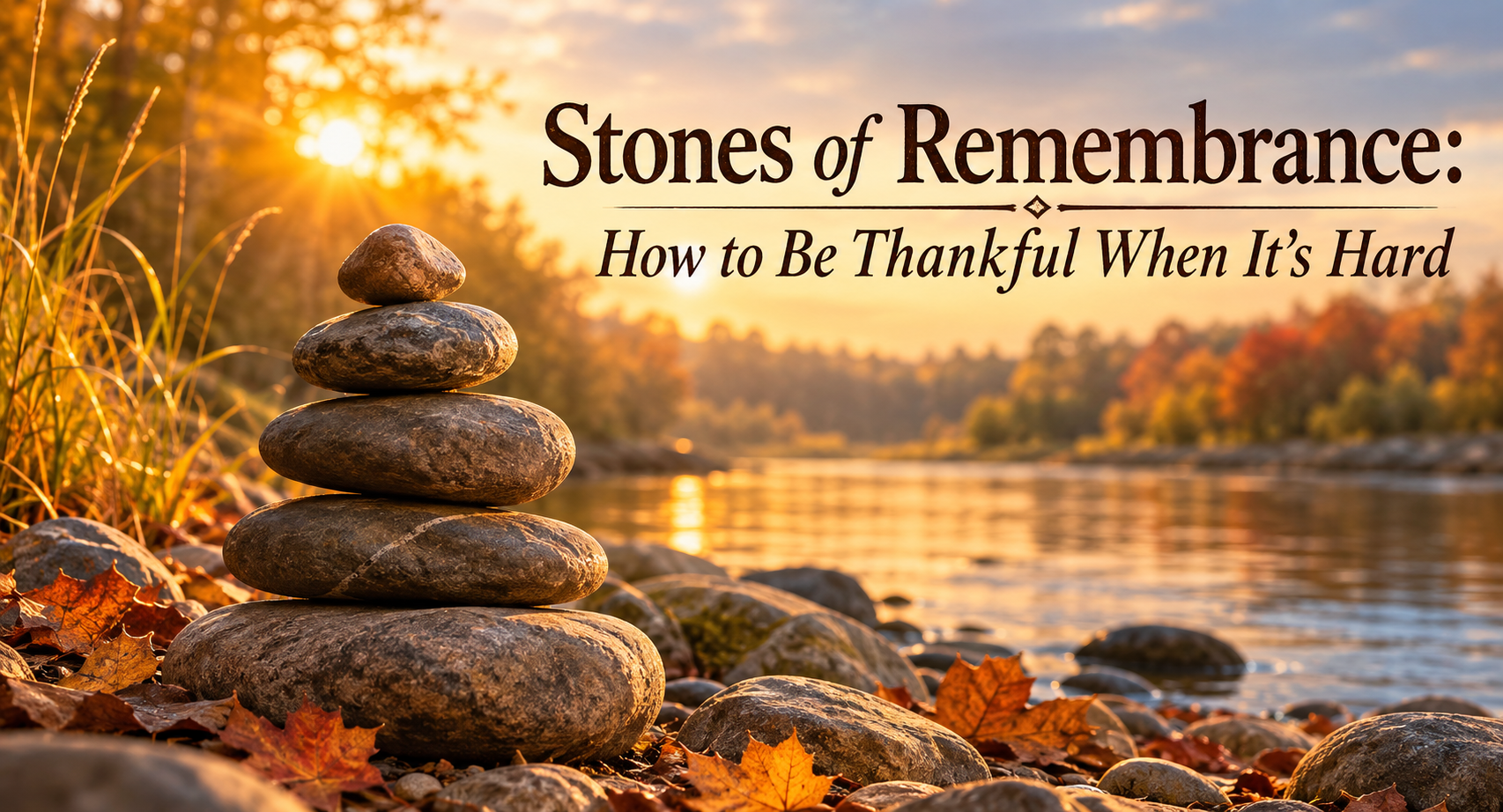
When Israel crossed the Jordan, God told them to stack 12 stones as a memorial (Joshua 4:6–7). Twelve stacked stones don't happen in nature. Children would ask what they meant, and parents would tell how God stopped the river so His people could cross on dry ground.
I have stones like that. At 17, God filled me with the Holy Spirit and changed my life. He made a way for a mission trip I couldn't afford. He brought Tina into my life right after I'd decided I would always be alone. He has healed me, given me words when I had none and provided two homes we could never have bought on our own.
One stone has lasted for years: provision. Tina and I started our marriage on $7.47 an hour. I worried about money constantly, until God healed me of that fear. Four years ago, God called us to start this church. I had to give up my salary, about 60% of our income, with zero safety net.
It wasn't scary. That's not because we're especially faithful. It's because we had seen God provide time after time, and we remembered it.
Who is your God?
Stones only help if we look back at them. When you face something hard, ask: have I been here before, and what did God do? I'll bet He was faithful then, and He will be faithful again.
Remembering what He has done leads us to remember who He is. "Remember His covenant forever" (1 Chronicles 16:15). His covenant says you are His child, made righteous, with death defeated and a future secured. It rests on what He does, not on what you do.
When Elisha picked up Elijah's mantle, he struck the Jordan and asked, "Where is the Lord God of Elijah?" I hear that as a declaration, not despair. So let me ask you: where is your God now?
- Facing a money problem? He supplies all your needs according to His riches in glory.
- Facing a hard diagnosis? He is Jehovah Rapha, the God who heals.
- Feeling invisible? He is the God who sees. He knows the number of hairs on your head.
- Anxious? He is the Prince of Peace.
- Carrying shame? Jesus became sin for you so you could become the righteousness of God.
If there's an area where you haven't yet known Him that way, that's an invitation to discover a deeper part of who He is.
Your challenge this week
Set up your own stones of remembrance.
- Get a journal this week.
- Write down two or three times God showed up and was faithful in your life.
- Thank Him for each one.
- Keep adding to it as you remember more, and as He keeps being faithful.
Tina and I started a journal like this and let it slide, so we're taking this challenge too. I bet that once you write the first few, more will come.
Thanksgiving isn't a once-a-year holiday. It's the framework of a believer's life: rooted, built up in Him and abounding in it with thanksgiving.
Oh, give thanks to the Lord, for He is good.